Socotra in General
Socotra or Suqotra (Arabic سقطرى) is a small archipelago of four islands and islets in the Indian Ocean. At 12o 30’N – 53o50’E the island lies about 240 km east of Somalia and about 380 km south of Yemen, some 200 kilometers off the Horn of Africa, 600 km due east from Aden, and some 400 km south of the Republic of Yemen mainland at Mukalla, which now administers the island. From the 16th to the 19th centuries, Socotra was administered by the Banu Afrar Mahra Sultanate of Qishn and Socotra, who continued in the 20th century under the British. The archipelago consists of the mountainous main island of Socotra (3665 km˛ ) and three smaller islands, Abd Al Kuri, and “the Brothers” Samha and Darsa, plus other uninhabitable rock outcrops. Abd Al Kuri and Samha have a population of a few hundred people between them. Darsa is uninhabited.
The climate is generally tropical desert, with rainfall being light, seasonal (winter) and more abundant at the higher ground in the interior than along the coastal lowlands.
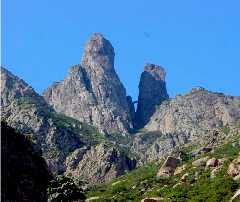
Socotra has three geographical terrains: the narrow coastal plains, a limestone plateau permeated with karstic caves, and the Hagghier mountains.
Socotra is one of the most isolated bits of land on earth, being of continental landmass origin (i.e., not of volcanic origin). The island probably detached from Africa as a fault block, in the same set of rifting events that have opened the Gulf of Aden to its west. The long geological isolation of the archipelago and its fierce heat and drought have combined to create a unique and spectacular endemic flora that would be highly vulnerable to change. Surveys have revealed that more than a third of the 900 or so plant species of Socotra are found nowhere else in the world. Botanists rank the flora of Socotra among the ten most endangered island floras in the world. The archipelago is a site of global importance for biodiversity conservation and a possible center for ecotourism. The Semitic language, Socotri, is only spoken on the archipelago, although there is a large colony of Socotrans living near Dubai.
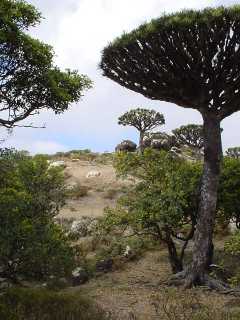
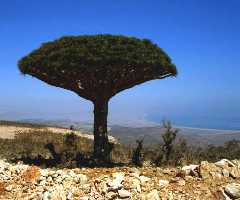
One of the most striking of Socotra's plants is the dragon's blood tree (Dracaena cinnabari), which is a very strange-looking, umbrella-shaped tree. Its red sap was the dragon's blood of the ancients, sought after as a medicine and a dye.
As with many isolated island systems, bats and civet cats are the only mammals native to Socotra. In contrast, the marine biodiversity around Socotra is rich, characterized by a unique mixture of species that are also found in far flung biogeographic regions, such as the western Indian Ocean, the Red Sea, Arabia, East Africa and the wider Indo-Pacific.
The monsoonal climate is strong. From June to September the island has traditionally been inaccessible, because of exceedingly strong monsoon winds, high seas, and strong ocean currents. In July 1999 a new airport opened Socotra to the outside world all year round. Most Socotrans still live without electricity, running water or a paved road, but these facilities have increased somewhat since 2002. At the end of the 1990s a United Nations Development Program was launched with the aim of providing a close survey of the island of Socotra, and some development has occurred alongside this program.